

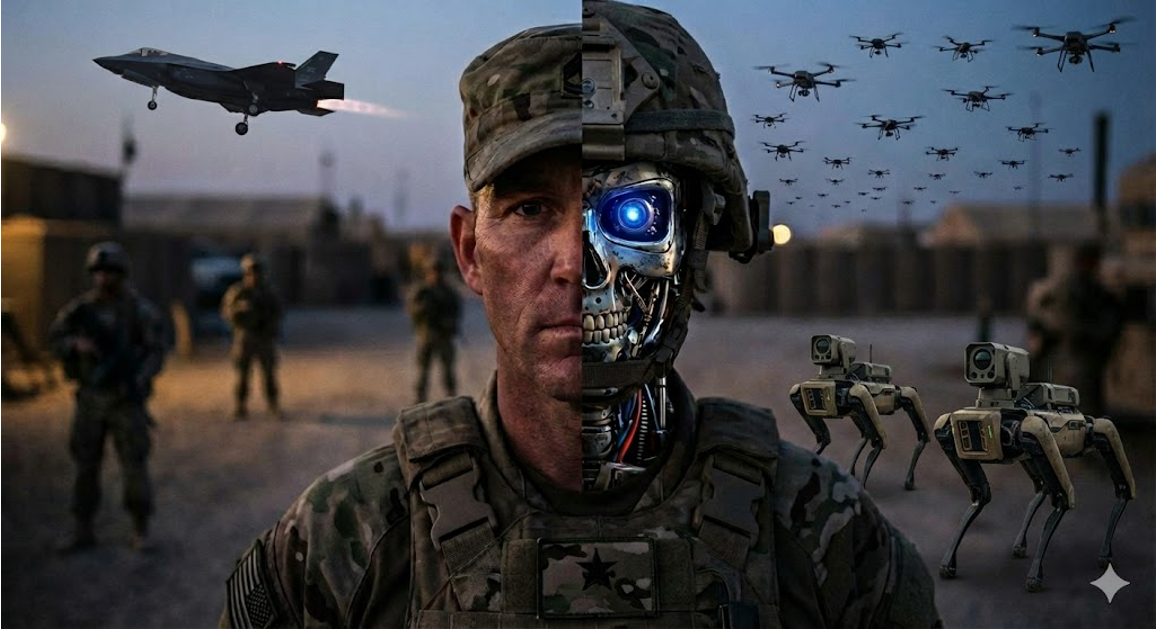
Five thousand years of recorded history reveal that war is a very human endeavor. While that truism may endure, it will be sorely challenged in the near future by shifts in the operating environment, such as the introduction of artificial intelligence and the fielding of millions of drones. This raises a critical question: what happens when a human endeavor runs out of humans? While the defense community rightfully obsesses over magazine depth and supply chains, the most critical vulnerability for modern state actors is personnel. Future demographics reveal a marked decline in eligible youth, severely restricting a country’s ability to resource and maintain traditional military forces. As the conflict in Ukraine demonstrates, the shift toward unmanned systems has not reduced the demand for soldiers. This article explores four possible futures, concluding that militaries must ultimately pivot to unmanned mass to survive.
The Problem: Demographic Exhaustion
A recent Center for a New American Security study projects a 13 percent decline in Americans turning 18 between 2025 and 2041. Effectively, the United States will have one million fewer potential recruits in a decade. This creates a supply-demand problem that can only be mitigated through ballooning personnel budgets, a return to peacetime conscription, or a radical divestment from manned platforms.
This crisis is not isolated; U.S. partners and allies face steeper declines. As scholar Tom Le identifies, Japan is vastly outnumbered in active-duty force levels.
In 2022, the number of Japanese military personnel stood at a measly 227,843, while the United States had approximately 1.3 million active forces and South Korea about 500,000 (Seoul has around a further 3 million reserve forces). China’s military, on the other hand, features approximately 2 million active personnel, and North Korea’s about 1.2 million.
Where does this leave the United States? There are four potential paths: a return to peacetime conscription; economic escalation (paying more for a smaller force); a total embrace of autonomous mass; or a hybrid of the three.
Path 1: A Return to Peacetime Conscription
Since 1973, the U.S. has relied upon the All-Volunteer military. Conscription was removed as a means to acquire personnel for military service (although conscription is still maintained, via the draft, to acquire personnel during extremis). This has not been the case for other militaries across the globe reliant upon conscription. Russia’s invasion of Ukraine saw the increased use of conscription from Russia and Ukraine, and other European countries. The appeal of conscription lies in its capacity to increase military personnel levels while curbing defense spending. The United States, facing declining military personnel levels since World War II, could implement a mixed system in the near future reliant upon peacetime conscription, maintaining a small cadre of volunteers augmented largely through a steady flow of conscripts. While modern warfare increasingly requires technical and specialized skillsets that conscription is unlikely to produce, the U.S. military could still leverage conscription to rapidly increase personnel levels for many roles while reducing overall costs. This would be a direct reversal of the Nixon era decision to divorce the US military from conscription.
The debate surrounding conscription has existed since the dawn of the American colonies, hitting a crescendo during the Vietnam era, where President Nixon made the campaign promise that ultimately divorced the United States from conscription. Nixon later admitted the flaws of a purely volunteer military, an admission worth quoting in full.
I considered the end of the draft in 1973 to be one of the major achievements of my administration. Now seven years later, I have reluctantly concluded that we should reintroduce the draft. The need for the United States to project a strong military posture is now urgent, and the volunteer army has failed to provide enough personnel of the caliber we need for our highly sophisticated armaments. Its burden should be shared equally by all strata of society, with random selection and as few deferments as possible. Even so, it will cause hardships, and whatever its form, the draft is inherently unfair; it can only be justified by necessity. But as we look at the 1980s, necessity stares us in the face: we simply cannot risk being without it. To put off that hard decision could prove penny wise and pound foolish; our reluctance to resume the peacetime draft may make us weak enough to invite war, and then we will find ourselves imposing a wartime draft instead.
However, scholars suggest a return to total war is upon us, which depends first and foremost on the ability to raise and maintain military forces, echoing Nixon. Conscription provides a solution as future demographic levels decline. Since political and social constraints render conscription unpalatable outside of existential conflict, it is imperative to evaluate the remaining three future possibilities.
Path 2: More Money, Fewer People
If military personnel levels must remain constant while demographics decline, pay must rise. This isn’t original scholarship on my part; just thumb through the final report of the Gates Commission to see the principles that drive a volunteer military are largely economic. This supply-demand issue increases in severity for technical skillsets the military is growing reliant upon. With technical skillsets proliferating, recruiting and retaining such skillsets is impeded by historically inflexible military pay tables, predicated on rank and years of military service instead of market compensation derived by occupational requirements. As the military seeks to leverage robotics, artificial intelligence, and other advanced technologies, competition for qualified individuals against a labor market that has better flexibility in compensation and work requirements will erode recruiting and retention if military pay fails to increase.
If the current struggle to man cyber occupations is a bellwether for the future, the military faces a steep uphill battle in securing technical talent. The most recent review on military compensation recommends increasing regular military compensation “to maintain competitiveness against future labor market challenges.” Increasing pay to remain competitive is desirable but creates a strategic trap: growing personnel costs cannibalize the budgets needed for modernization and readiness—the “iron triangle” of defense trade-offs—if budgetary top-lines do not also increase. This solution is also assumed to be undesirable from a civilian leader and societal aspect given current fiscal realities.
Path 3: The Unmanned War
Technology rarely reduces personnel requirements; drones often require more logistical support than the manned systems they replace. However, an unmanned war becomes sustainable when we move from remote-controlled to more autonomous systems. The primary obstacle is cultural tribalism. Senior leaders must be willing to divest of their own occupations—such as manned aviation—to realize the fiscal and strategic benefits of robotics.
While I can only imagine the uproar after making this recommendation, the unmanned war is one that remains financial sustainable while offsetting declining demographics allowing the military to generate and maintain a level of mass required for great power competition and all-out war. Shifting from manned to unmanned platforms is step 1. Shifting from unmanned to autonomous platforms is step 2. However, having the military services divorce themselves of manned aviation and other ground platforms has been slow even under ideal circumstances. Trying to pursue manned and unmanned systems—never stepping back and realizing within the personnel ecosystem, maintaining both is expensive and redundant—actually negates the benefits of unmanned systems if manned platforms are not concurrently removed.
A former service chief identified the issues associated with manned aviation and demographics, “if the force cannot generate and retain enough pilots (a chronic problem with no solution in sight), perhaps it is time to abandon warfighting concepts that rely on large numbers of manned aircraft.” The argument also recognized the alternative where large numbers of manned aviation platforms are a requirement, requiring higher resource allocation to attract and retain sufficient pilots. One could argue the former presents a more acceptable and prudent future than the latter in great power conflict from cost and risk perspectives. This article assumes the former is more acceptable than the latter due to the cold truth that unmanned systems, when lost, don’t require paying out insurance or death gratuities, with missiles and autonomous systems having no requirement for health care, housing, or quality of life.
Path 4: The Hybrid Solution
A hybrid solution, a combination of the previous recommendations, does two things. First, it generates mass through systems not people. Second, and more importantly, it lowers overall costs for maintaining military forces with people growing increasingly scarce. A hybrid force reduces end-strength to cut costs while generating mass through autonomous systems. Arguments for future manned platforms should be met with skepticism from cost and risk perspectives. If self-driving “robotrucks” can handle logistics within the United States, when employed in a military scenario a total loss is only hardware—not lives—to an improvised explosive device or other munition. While the unmanned solution seems to produce a cost, risk, and militarily effective future, it is not lost on me that people will rarely divorce themselves of what they know. The military has long been a personnel heavy institution with militaries deriving their identity and culture from personnel. A hybrid solution could reduce overall end-strength levels to lower burgeoning personnel costs, while generating mass not through conscription, but with autonomous systems.
You’re out of your mind
The likely criticism is I’m a futurist with no grasp of reality, willing to bite off on the latest technology completely divorced from the requirements of war. To those making that argument, two things I’ll offer for consideration. First, I’m not trying to be a heretic, only convey a cost-effective solution, understanding the level of people available for military service in the future will decline. Understanding this article is easily categorized as technophilic, such a categorization is driven first and foremost by a focus on personnel (Worth noting, I’m not a luddite either). With personnel remaining the critical magazine depth for all militaries, it’s time to explore new futures if the information available today indicates personnel levels are declining. Second, my entire career has revolved around manned aviation. I am writing this understanding I’m recommending a future where I don’t exist. However, it’s not about if I exist, or my occupation exists, it’s about if the United States military is structured appropriately with the ability to endure while balancing fiscal realities and strategic requirements. There exist various low-cost, off-the-shelf technologies with the ability to degrade or defeat the most advanced air and land platforms within the U.S. arsenal providing instant scalability, mitigating the cost imposition the U.S. military faces through the continued pursuit of exquisite, expensive, manned platforms.
Conclusion
Current personnel shortages may paradoxically present an opportunity. As joint concepts pivot from technological to human innovation, the scarcity of people becomes a driver for change. Viewing personnel through an instrumentalist lens—as simply a form of ‘materiel’—suggests that a decline in supply can catalyze change. This aligns with the work of military innovation scholar Stephen Peter Rosen, who argues that successful military innovation is not dependent on abundance; rather, it can—and often does—occur during peacetime and under strict resource constraints, conditions that mirror the present moment. However, if military concepts require shifting from technology to human innovation, such a shift has yet to remedy a personnel system that has remained largely unchanged since World War II. This creates lopsided organizational capability, the product of decades of technological innovation paired with invariant personnel strategies.
We know the future will have both more violence and less people. This is not an asserted theory, but a mathematical certainty—what will militaries do in light of that fact? While I proposed four possible futures, there are likely others that should be explored. There is also a counterargument that what I proposed is dramatically out of step; I have but one response. Since World War II, military personnel levels have declined, and now we know demographics are similarly declining. Knowing mass is critical to the future, how will the United States military generate mass that satisfies societal, fiscal, and strategic constraints while still preserving the ability to maintain an effective military? The answer lies in creating affordable mass through technology while adjusting personnel levels to balance the iron-triangle of painful defense tradeoffs.
Well done!! Wow!
Ref volunteer military service in the US Military is economic driven:
No, it’s not. 80% of the military is generational service- the same people from the same families.
As anyone who served knows. As the recent surge in recruiting when moral and true leadership took over in 2025 proves for those concerned with numbers- there’s your quantifiable proof.
The Marines who always maintained high standards and morale never had difficulty meeting recruiting numbers.
That military service was the same people from the same families is a commonplace although I was surprised it was 80%.
The answer is of course hybrid of technology and people but this has always been true.
The solutions will be found as they are already being found- by pushing tools to the frontline soldiers and letting them figure out the solutions.
Our top down doctrinal decisions have been failing since 1914.*
The takeaways on drones are quite available from the Ruso-Ukrainian war as well as other conflicts, my own suggestion is Economy Of Flesh and heavy reconnaissance, far less mass.